Young children learn through their senses long before they can explain everything they are thinking. Touching, pouring, scooping, sorting and experimenting with different textures helps them understand the world in a natural way.
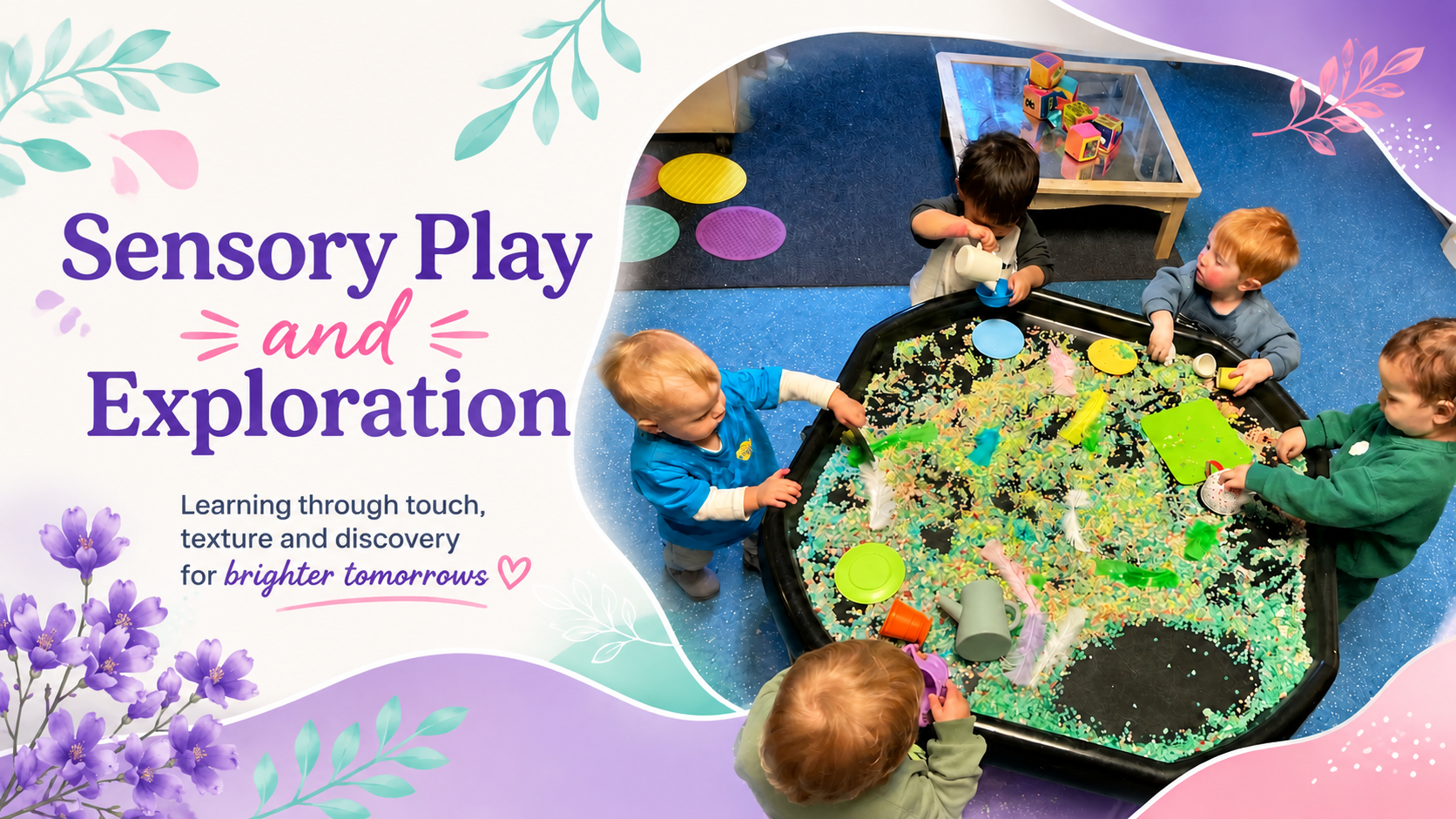
At Jacaranda Childcare Centre, sensory play is used as part of meaningful, play-based early learning. In the activity shown, children are exploring a sensory tray filled with colourful materials, feathers, cups, bowls and scooping tools.
The experience looks playful, but it also gives children opportunities to practise coordination, communication, curiosity and independent decision-making.
For families searching for childcare in High Wycombe, sensory experiences like these show how everyday play can become purposeful early learning.
What Is Sensory Play?
Sensory play is any activity that encourages children to explore using one or more of their senses.
Children may investigate:
- different textures
- colours and shapes
- movement
- sounds
- weight
- temperature
- how materials behave when moved or combined
A sensory tray can be especially useful because children can interact with the same materials in different ways.
One child may enjoy scooping. Another may focus on pouring. Someone else may spend time touching the feathers or moving objects around the tray.
Each child can explore according to their own interest and stage of development.
Learning Through Scooping and Pouring
Simple actions such as filling a cup, tipping it out and repeating the process can support early learning.
Children begin to notice that their actions create results.
They may discover:
- what happens when a container becomes full
- how materials move from one place to another
- which tools hold more or less
- how quickly materials pour
- what happens when different objects are mixed together
These experiences introduce early ideas connected with volume, quantity, cause and effect.
At the same time, children are strengthening their hands and practising coordination.
Supporting Fine Motor Development
Fine motor skills involve the smaller muscles of the hands, fingers and wrists.
During sensory play, children may grasp cups, hold spoons, pick up small objects and control the movement of different tools.
These actions help develop skills that later support everyday tasks such as:
- drawing
- using scissors
- dressing
- feeding independently
- turning pages
- early writing
For parents comparing a childcare centre High Wycombe, hands-on activities can provide useful insight into how a centre supports development through everyday play.
Encouraging Curiosity and Problem-Solving
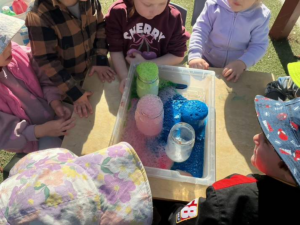
Sensory experiences naturally encourage children to investigate.
They may wonder:
- Can I fill this cup?
- What happens if I tip it?
- Can I move these materials with a spoon?
- Which container should I use?
Children do not need formal instructions to begin solving these simple problems. They learn by experimenting.
This process helps children develop persistence and flexible thinking because they can try different approaches until they find one that works.
Building Independence Through Choice
Sensory play often gives children several materials and tools to choose from.
Instead of every child completing exactly the same task, they can decide how they want to interact with the activity.
This supports independence.
A child might choose a particular scoop, move to another section of the tray or repeat an action many times because they are interested in what happens.
Making small choices helps children gain confidence in their own ideas.
At Jacaranda Childcare Centre, these opportunities can make learning feel natural rather than forced.
Social Learning Around a Shared Sensory Tray
Sensory activities can also become valuable social experiences.
When several children explore the same tray, they learn to share space and materials. They begin to notice what other children are doing and may copy, communicate or exchange tools.
These moments can help develop:
- turn-taking
- sharing
- communication
- patience
- cooperation
- friendships
Children learn social skills through repeated everyday interactions rather than through formal lessons alone.
Language Development During Sensory Play
Sensory activities give educators many opportunities to introduce useful words.
Children may hear words such as:
- soft
- rough
- full
- empty
- more
- less
- pour
- scoop
- feather
- cup
- colour
Educators can describe what children are doing and ask simple questions that encourage communication.
For example:
- “What are you scooping?”
- “Is your cup full?”
- “Which feather would you like?”
- “What happens when you pour it?”
These conversations connect language with real actions, making new words easier for children to understand.
The Role of Educators
Educators play an important role in making sensory experiences safe, engaging and age-appropriate.
They can prepare suitable materials, supervise the activity and allow children enough time to explore.
They may also extend learning by introducing new tools, demonstrating different actions or asking questions.
The goal is not to control every part of the activity. Instead, educators can provide support while allowing children to investigate independently.
This balance helps children build confidence as active learners.
Sensory Play and Emotional Wellbeing
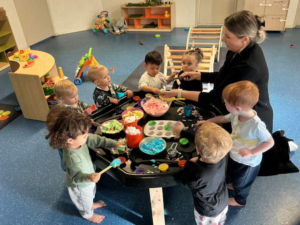
Sensory activities can also provide children with calm, focused moments.
Repeating actions such as scooping, pouring or moving materials can be enjoyable and absorbing.
For some children, this type of play gives them time to concentrate quietly. For others, it becomes an energetic social activity.
Having different ways to participate allows children to engage in a way that feels comfortable for them.
A supportive early learning centre High Wycombe should recognise that children have different interests, personalities and learning styles.
Play-Based Early Learning
Play-based learning allows children to develop skills through experiences that are enjoyable and meaningful.
Sensory play is one example of how several areas of development can be supported during one activity.
Children can work on:
- fine motor skills
- language
- early maths concepts
- social skills
- problem-solving
- coordination
- confidence
- independence
All of this can happen while children simply feel that they are playing.
That is one of the strengths of early childhood learning through play.
Why Parents Should Look Beyond the Activity
When parents see a sensory tray, art activity or messy-play experience, it can be helpful to look beyond what the activity appears to be on the surface.
The important question is not only, “What are the children doing?”
It is also:
What are they learning while they do it?
A well-planned sensory experience can support several developmental areas at once.
For families searching for daycare High Wycombe, this is worth considering when comparing local early learning options.
Choosing Childcare in High Wycombe
When visiting a childcare centre, parents can observe how children engage with activities.
Useful things to look for include:
- Are children able to explore independently?
- Are educators nearby and engaged?
- Are materials suitable for the children’s ages?
- Do children appear interested and comfortable?
- Are there opportunities for both individual and group play?
- Do activities encourage communication and problem-solving?
These observations can help families understand how learning happens during an ordinary day.
Supporting Local Families
Jacaranda Childcare Centre is located in High Wycombe and may also be convenient for families from nearby suburbs.
Parents searching for childcare near Forrestfield, or childcare around Maida Vale may consider High Wycombe when comparing early learning options.
A convenient location combined with a nurturing learning environment can help families create a consistent daily routine for their children.
Final Thoughts
Sensory play may look simple, but it can support many important areas of early childhood development.
Scooping, pouring, exploring textures and sharing materials helps children build fine motor skills, curiosity, language, confidence and social awareness.
At Jacaranda Childcare Centre, sensory experiences give children opportunities to investigate, make choices and learn through meaningful play.